Wild Wild Flows: Western Market Seams
The sparse western grid is no stranger to seams, but as market development continues, the topic has never been more salient. We look at power flows across the West and the evolving interplay of transmission across balancing authorities.


The western US was shaped by the frontier. From gold to silver and beyond, people sought riches in isolated locations across a rugged landscape. Communities formed in pockets across the frontier, sustained by mining, logging, ranching, and farming. Lengthy stretches of rail connected these distant communities, and this diffuse patchwork is still reflected today in both the original industries, and the grid that now powers them.
Market Seams are interfaces between adjacent electric systems and administrators– such as balancing authorities, reliability coordinators, transmission service providers, and electricity markets – where neighboring entities perform essentially the same function on either side of a jurisdictional or ownership boundary within a shared network.
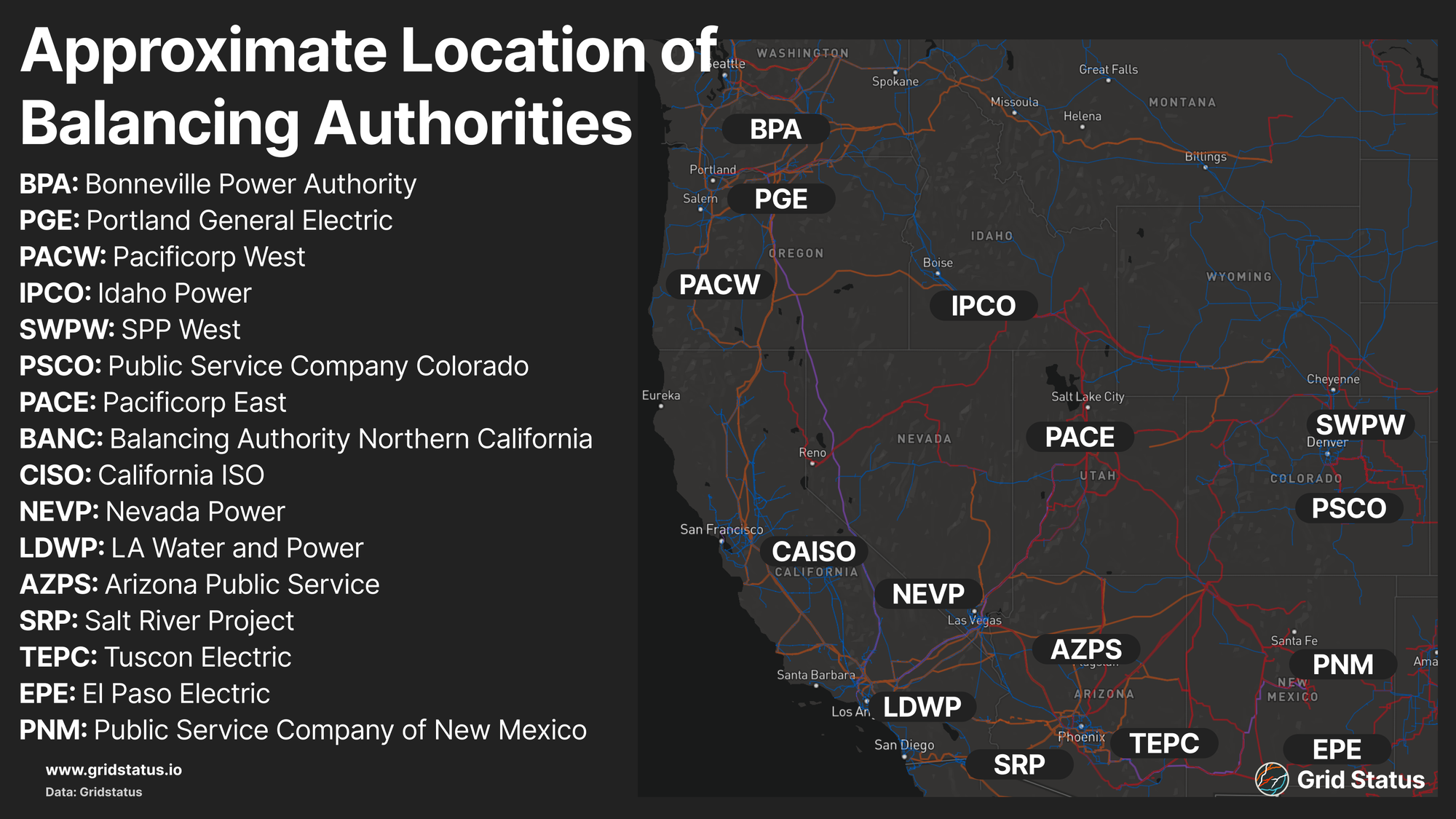
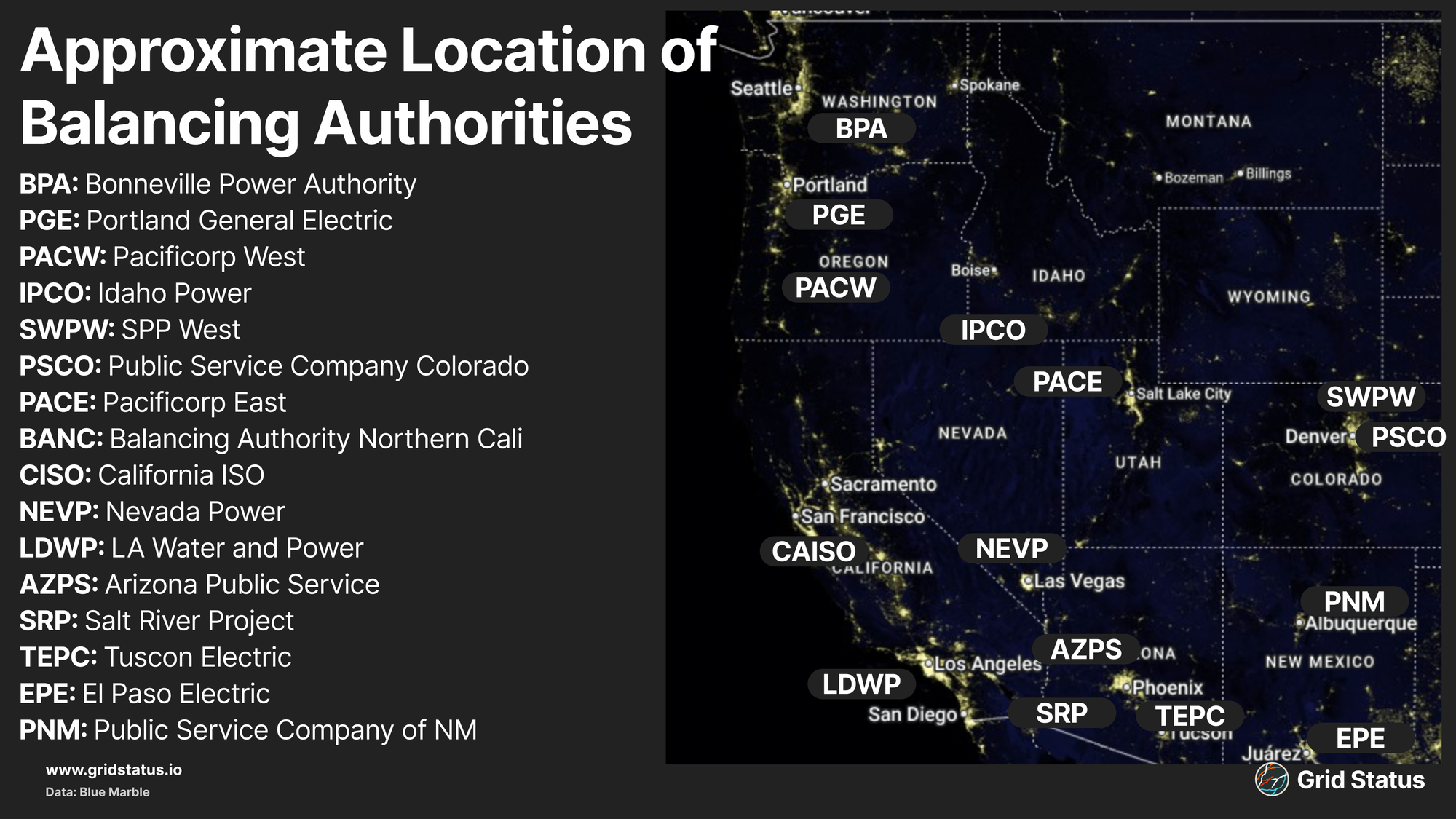
The frontier evokes the 1800s, but even today the Western Interconnection feels a bit wild compared to its Eastern counterpart. Almost 30 different balancing authorities (BAs) manage power assets, schedule transmission lines, and serve load. These entities don’t exist in a bubble; trading power, sharing assets, and helping each other out across variations in seasonality and resource availability. And unlike the southeastern US, even the non-RTO portions of the West have participated in a real-time balancing market administered by CAISO for over a decade. This complicated and unique situation is actively evolving with SPP’s western expansion and the genesis of both the Extended Day-Ahead Market (EDAM) and Markets+, so let’s take a look at flows around the West, their relationship to the CAISO pivot, and what we could expect moving forward as new markets aim to tame the Wild West.
Shoulder Season Heat Exposes Flows
The first week of October was anything but cool in California. Hot temperatures plagued not only the Central Valley but also the coast, increasing overall demand and evening day-ahead clears during outage season. The grid was tight, but overall conditions remained stable, in part due to California’s interconnection with the rest of the West.
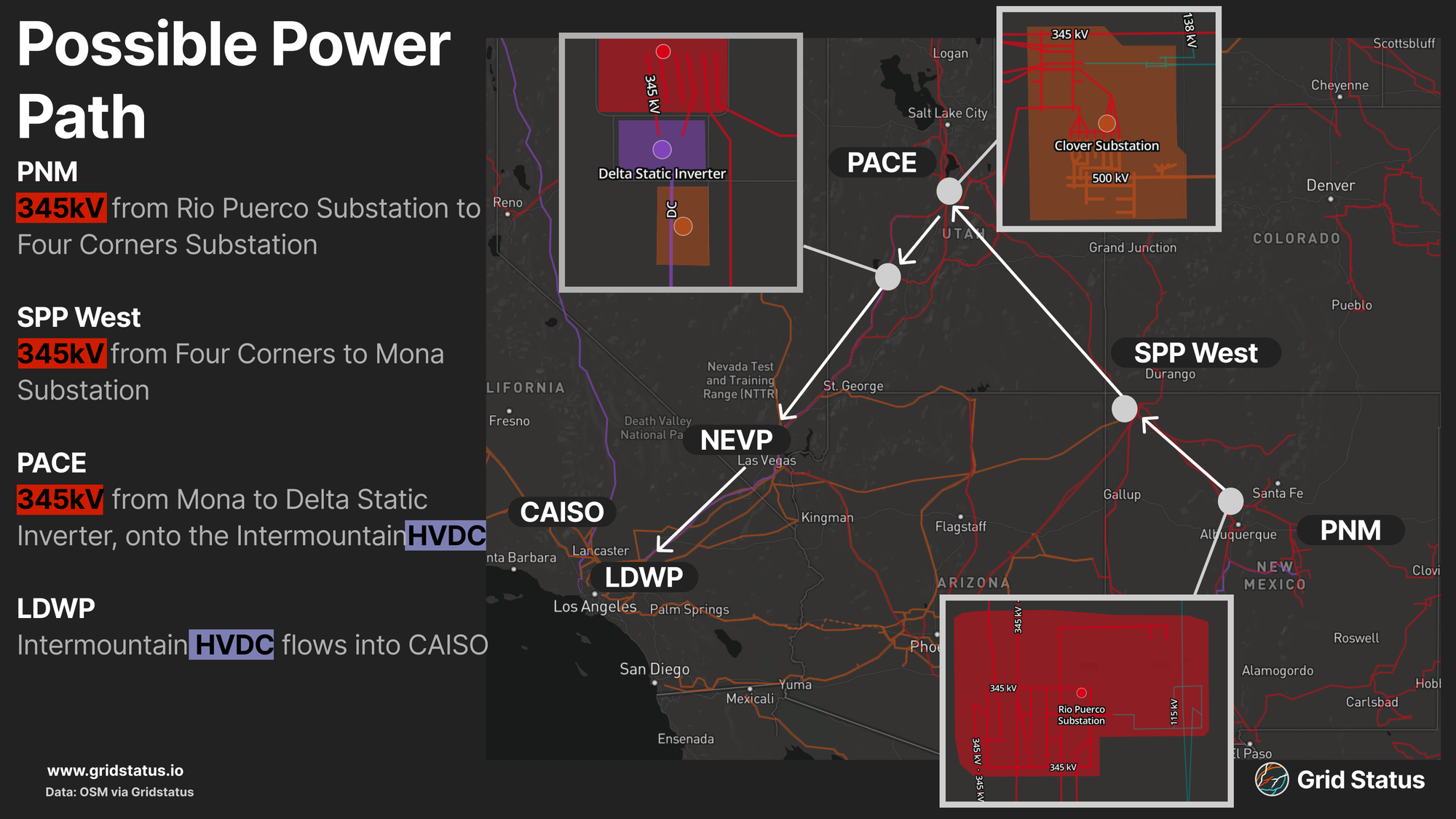
As load increased into the evening, flows from Northern CAISO into the southern portion of the ISO were getting tight and southbound congestion increased. In order to alleviate high LMPs from congestion in the Central Valley, it appears that power flows from outside of the ISO increased. As prices spiked, SPP West appeared to act as a pivot point, importing additional power from the Public Service Company of New Mexico (PNM), while increasing exports into PacifiCorp East (PACE), suggesting flows from PNM were sent to CAISO from SPP West and then PacifiCorp East. PACE then likely sent flows to LA Department of Water and Power (LDWP), which showed real-time exports into CAISO during the period of high prices.
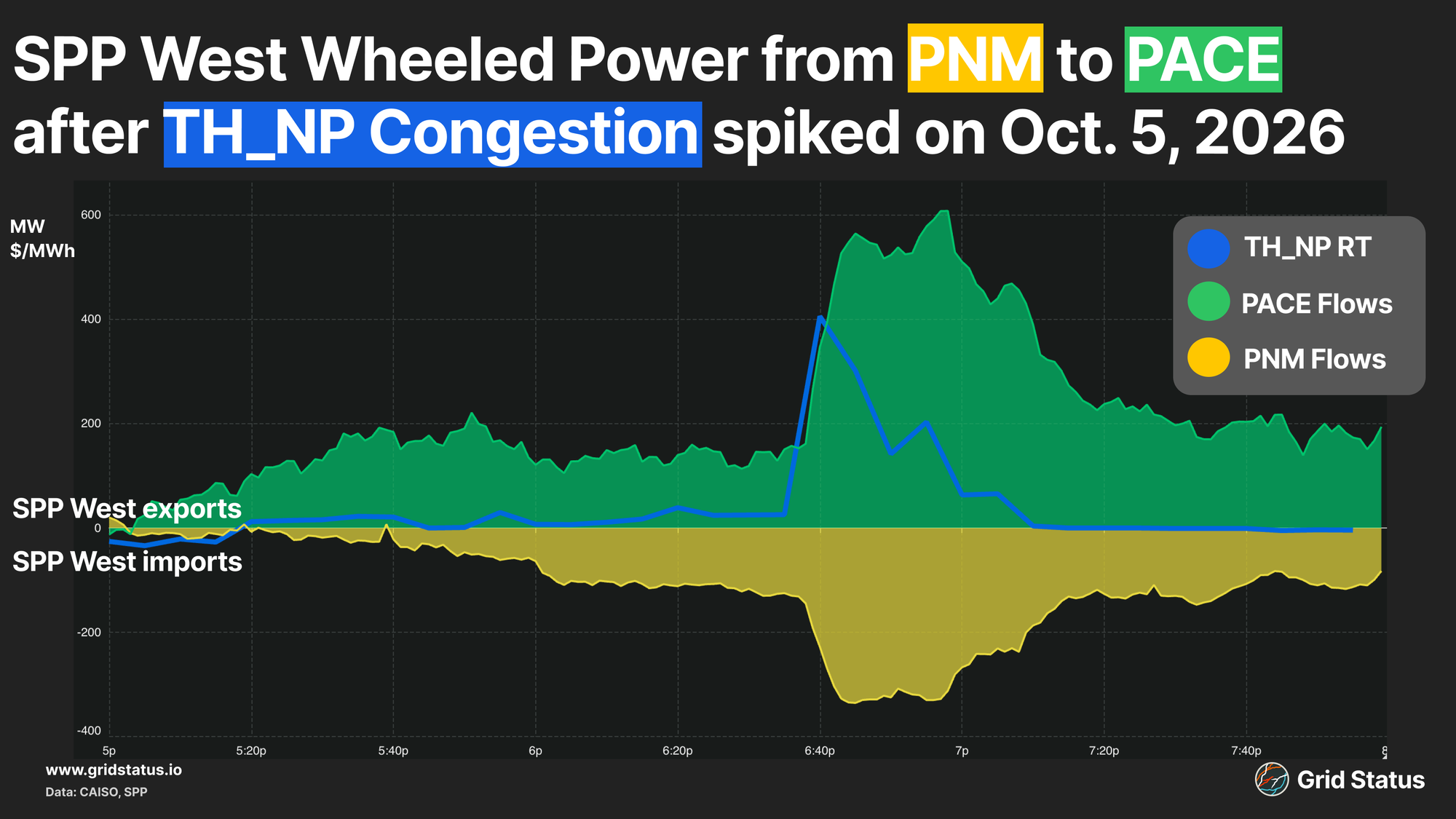
Congestion was elevated along nodes in the Central Valley. Higher congestion along TH_NP was seen compared to TH_SP. This physical price differential influenced how power flowed to help relieve price strength. PNM flows had to travel up to SPP West and over to PACE in order to help relieve high prices rather than flowing through Arizona in a more direct route.
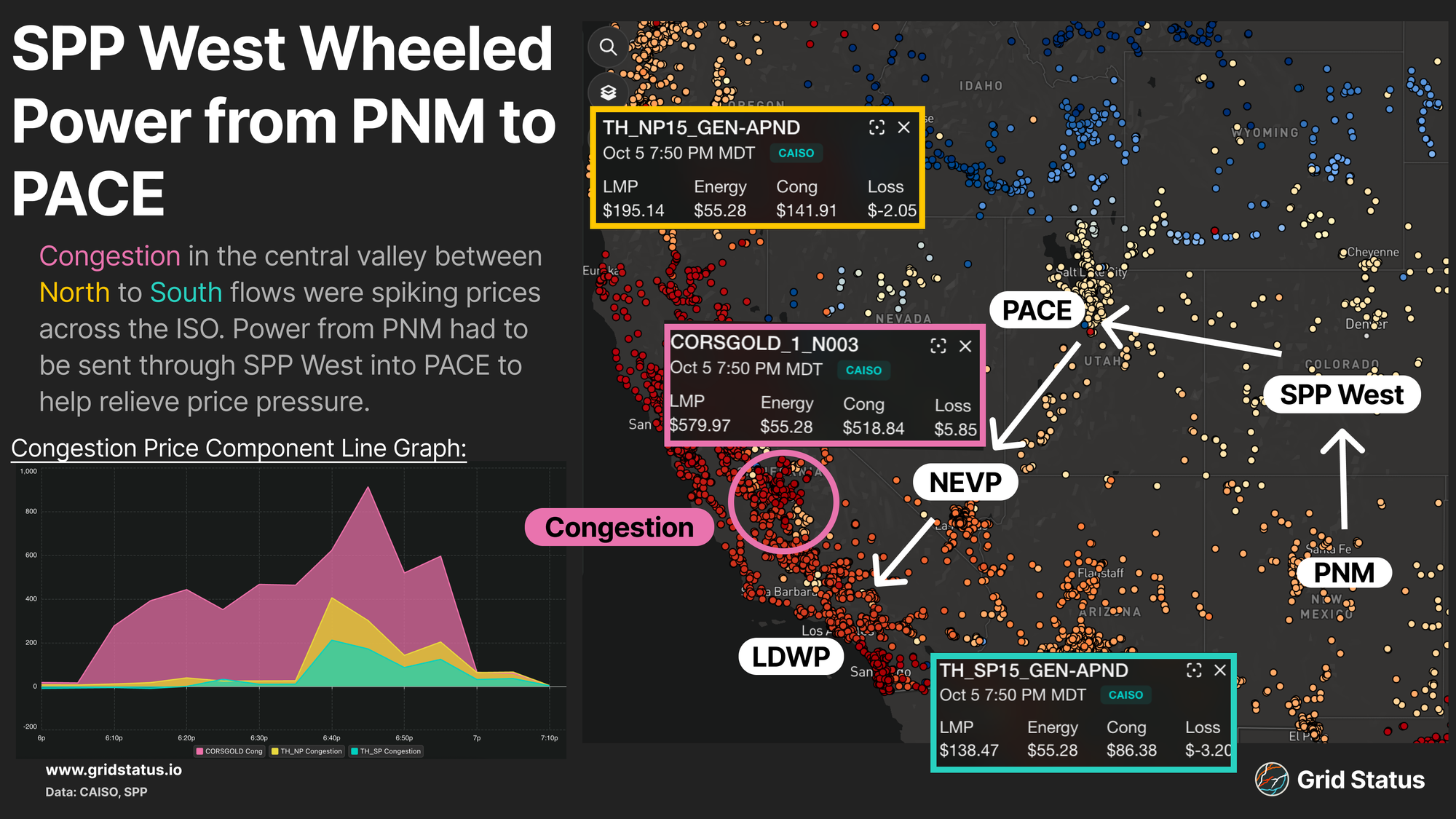
A possible path the power took could be viewed as follows: traveling on 345 kV lines out of PNM to the Four Corners substation via SPP West, then north into PACE before hopping on the Intermountain HVDC tie line that goes around Las Vegas into California.
The Mothership: CAISO
Until recently, California was the lone RTO in the Western Interconnection and has maintained an outsized impact within the region over the years. Internally, CAISO’s grid is heavily supported by imports from surrounding regions. Neighboring balancing authorities regularly maintain flows at the level of multiple GWs over the course of a day.
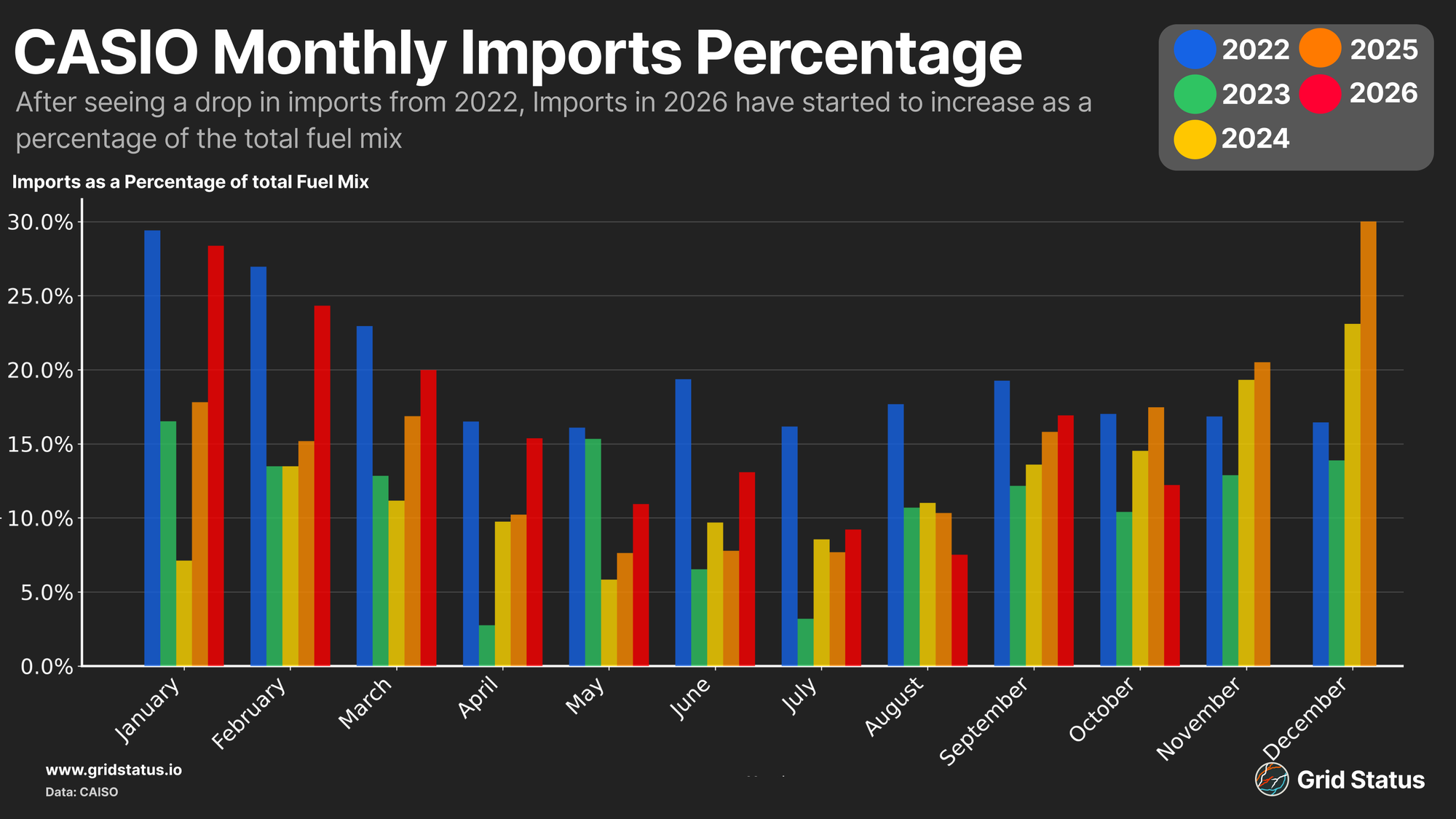
As solar generation grew, overall renewable penetration increased substantially in 2023 and 2024, and imports as a percentage of the fuel mix drastically decreased. However, load was also lower in these years. Recently, imports have seen an uptick, although not quite to 2022 levels. Let's see where flows are coming from.
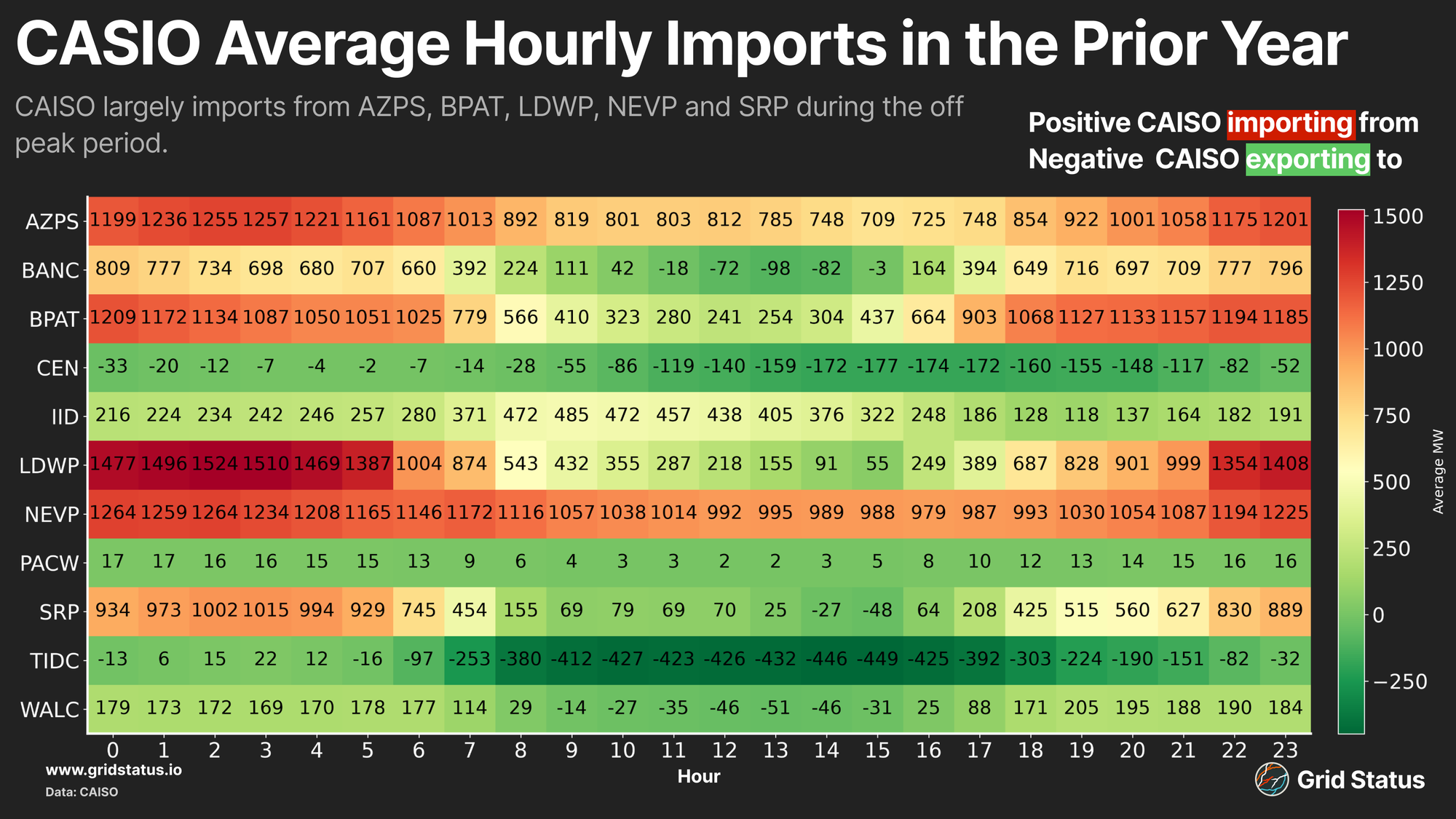
The bulk of CAISO’s imports come from 4 of its neighboring BAs: Arizona Public Service (AZPS), Salt River Power (SRP), Nevada Power (NEVP), Bonneville Power Authority (BPA), and LA Water and Power (LDWP). Flows into CAISO largely track the inverse of the sun, with imports being strongest during the off-peak. Economics drive this result, as solar generation is not online and thus wholesale prices are often stronger.
2026 has seen a decrease in natural gas generation, providing additional space in the stack for stronger imports. Increases in battery capacity and duration as well as 2GW of wind power from SunZia, have contributed to lower natural gas clears in the market due to shrinking economic operating windows. Thus, imports (namely thermals) from other balancing authorities step in to fill the gap, as these units can run more continuously without the same competing factors.
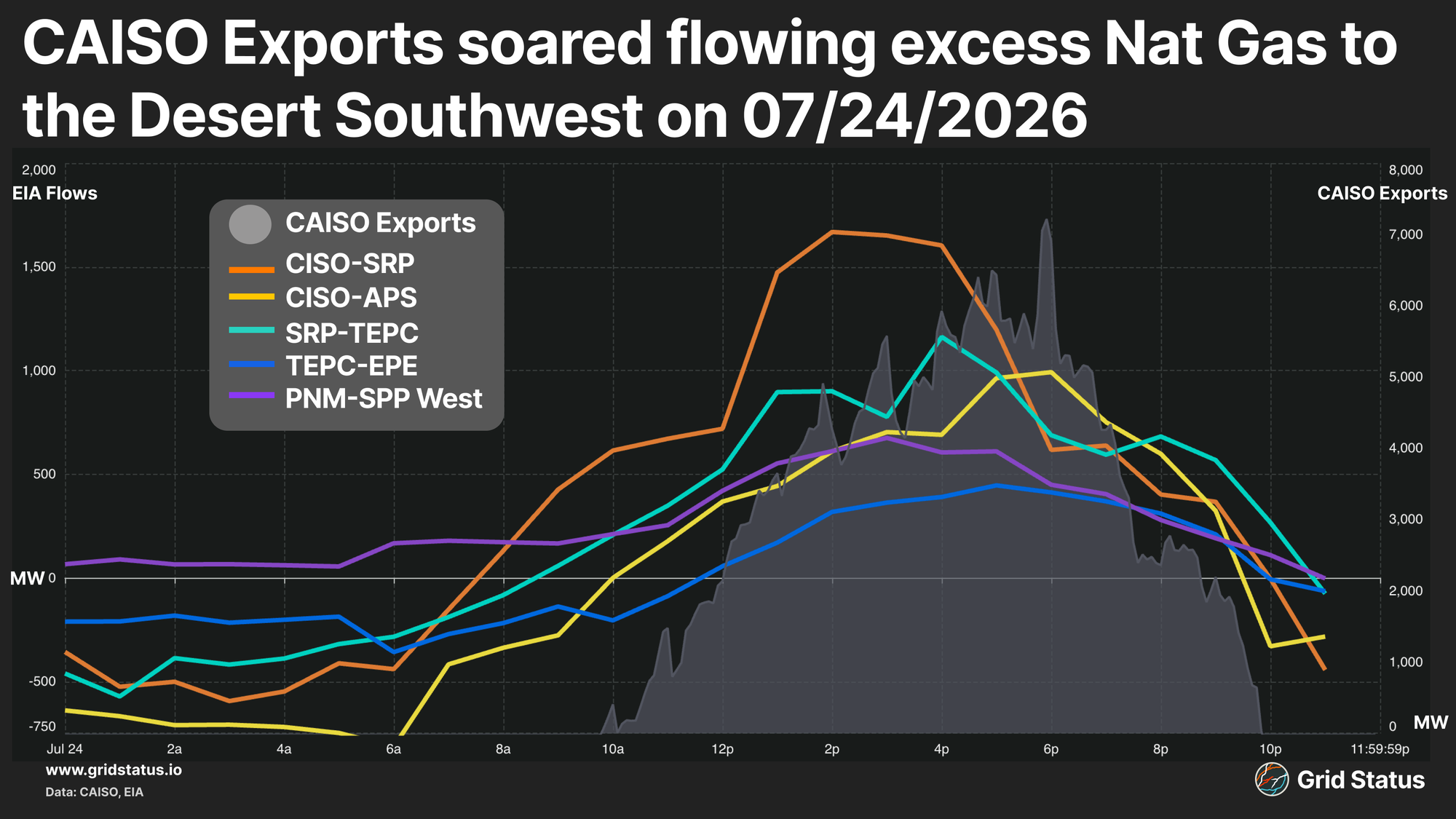
Looking at a CAISO dataset showing real-time flows, we see heavy real-time exports during the midday, showcasing the wealth of solar power that can be sent to neighbors when the ISO is unable to absorb this output via either native load or battery charging.
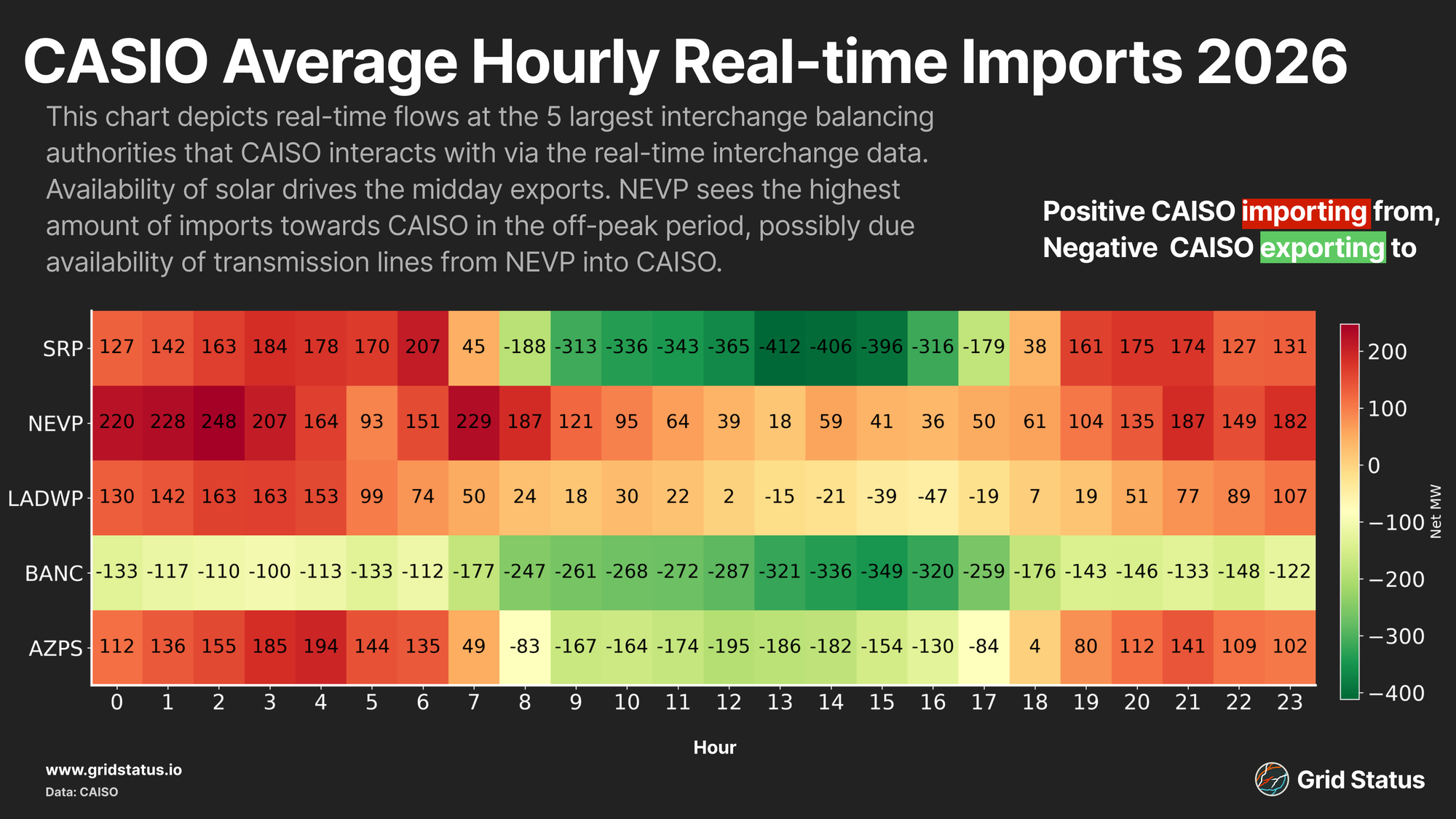
Real-time off-peak flows are highest from NEVP into CAISO; likely due to the surplus of transmission capacity: three 345kV lines and a DC tie line running from Las Vegas into California, providing substantial transfer capability. During the October heat wave, when CAISO needed power, it appeared to receive flows through LWDP via these high-capacity lines.
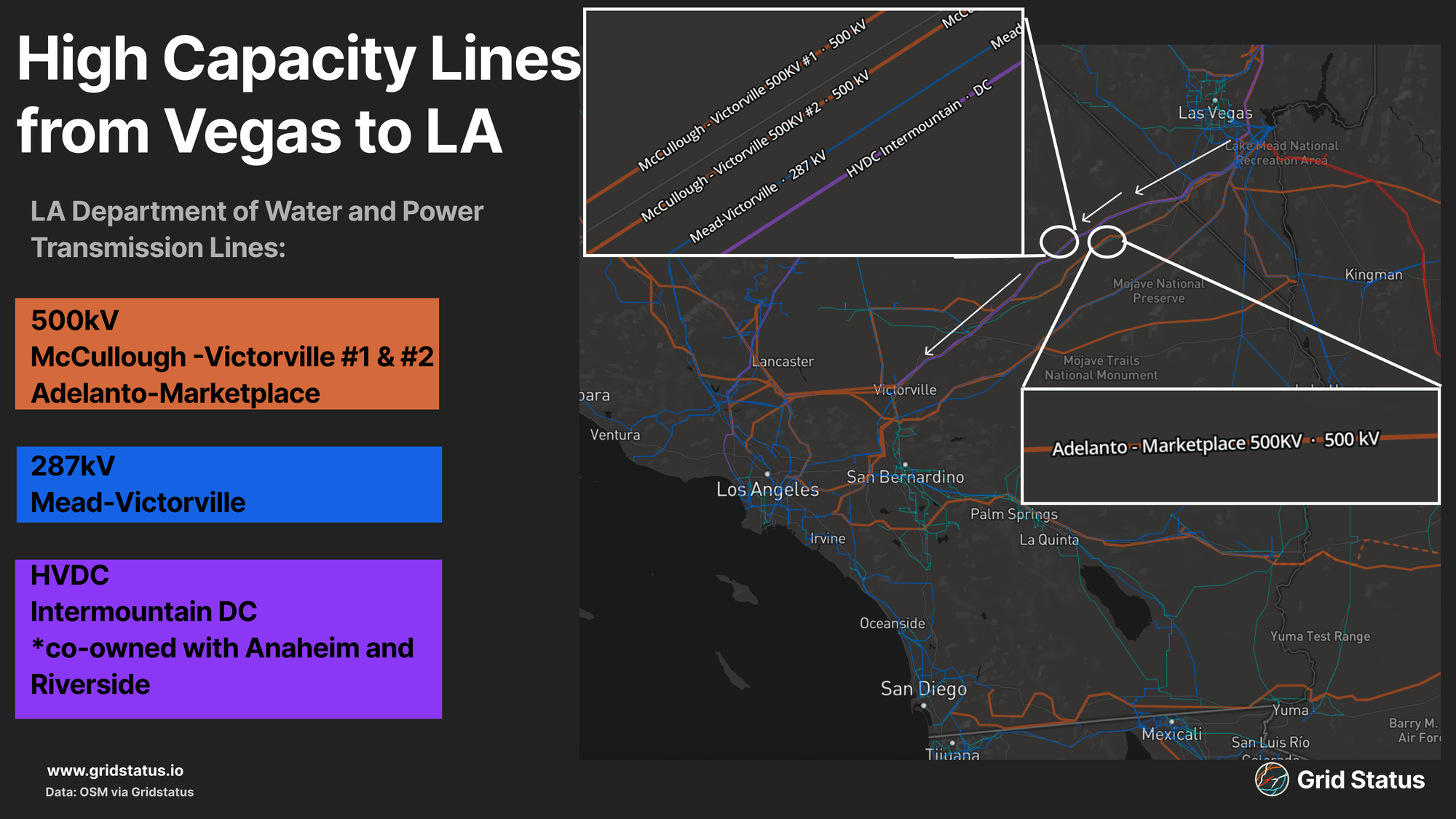
CAISO Rises to the Occasion with Neighboring Heat
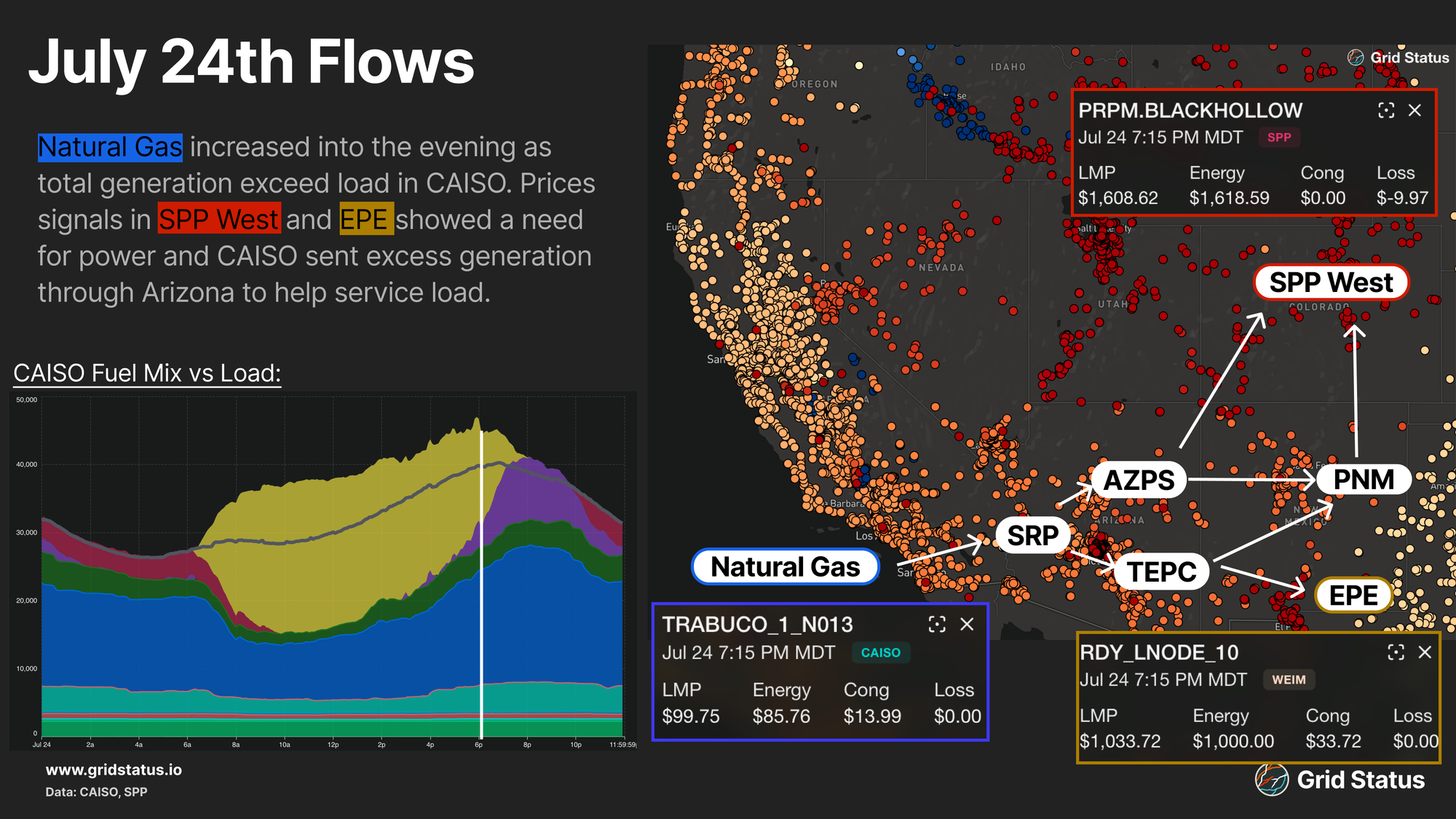
CAISO might be a net importer, but that doesn’t mean it won’t help neighbors in need. Sending excess solar isn’t the same as ramping up natural gas production to export and we saw that this past summer. Natural gas generation soared on July 24th,2026 in CAISO, and prices shot up among the Southern nodes, but CAISO was net exporting during this time to help out the extremely hot neighboring Southwest in the afternoon hours.
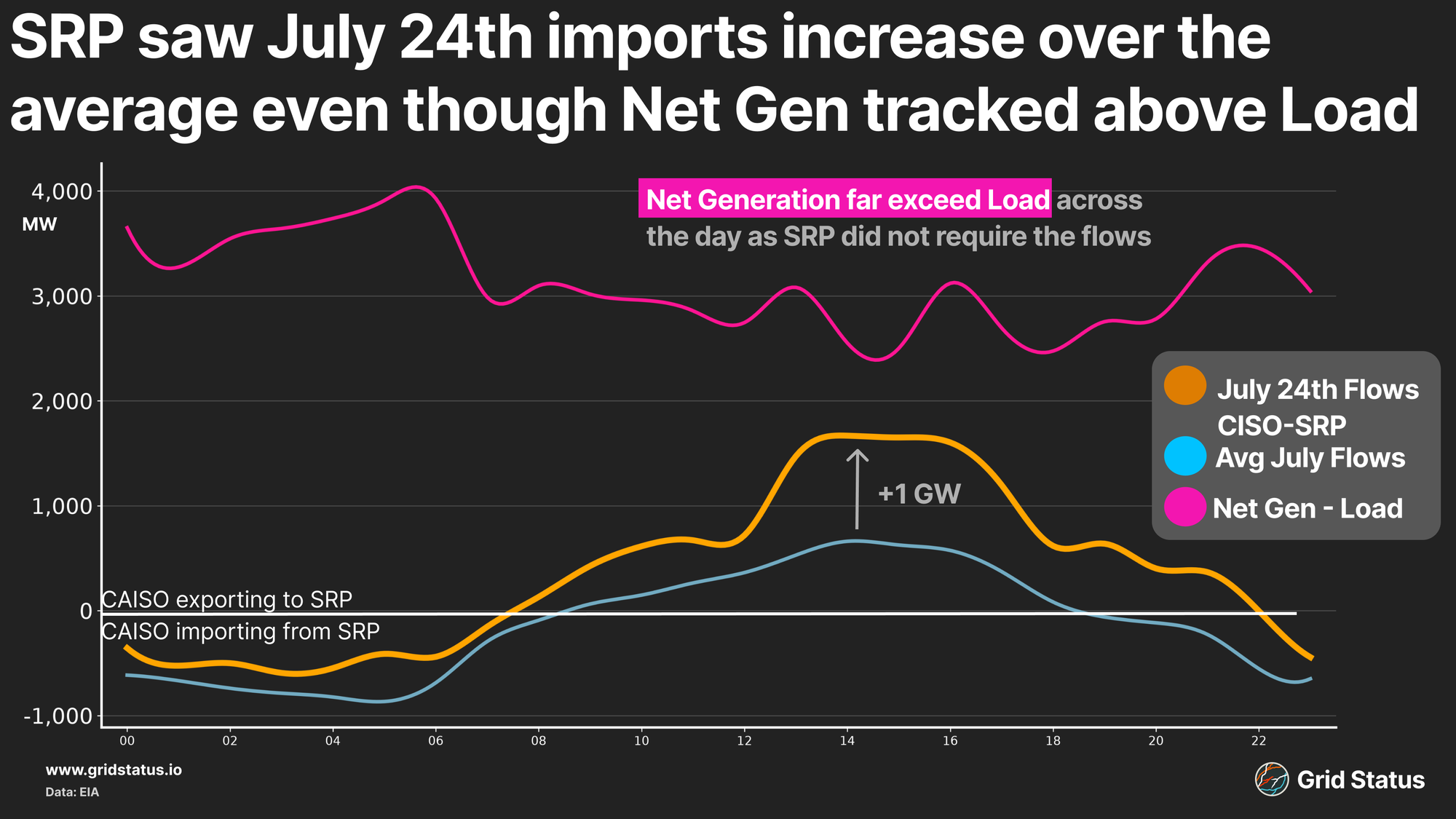
Flows from CAISO soared into SRP, AZPS, and NEVP. Out of this trio, SRP is unique as its net generation was well over its load; it was receiving flows from CAISO to then send on to Tucson Electric (TEPC), to then get wheeled to PNM, and ultimately end up in El Paso Electric (EPE) and SPP West. We can see some of this power flow through interchange data.
SRP usually doesn’t see such high flows from California, but 1 GW of flows over the average from July came into the system on July 24th. Net generation far exceeded load, and even the drop in the gap was less than the wealth of flows sent to the East.
Elevated natural gas did not track with CAISO fundamentals that day, as gas was rising even while prices did not signal a need for additional generation. However, prices were reaching market caps in SPP West and EPE. Thus, evening exports surged, traveling through Arizona to make it to the eastern side of the Western interconnect.
While it’s fun to see CAISO help out its eastern neighbors, let’s take a closer look at how adjacent Arizona and the Desert Southwest flows play into the system on a typical basis.
Flows in the not so Barren Desert
Three main balancing authorities make up Arizona: AZPS, SRP, and TEPC. A defining facility in the region is the Palo Verde Nuclear plant, an almost 4 GW nuke in the middle of the desert, and part of SRP. This single plant is most of SRP’s baseload generation on its own, and allows the BA to heavily export into not only CAISO but AZPS. Some of the power sent to AZPS is also wheeled through to CAISO.
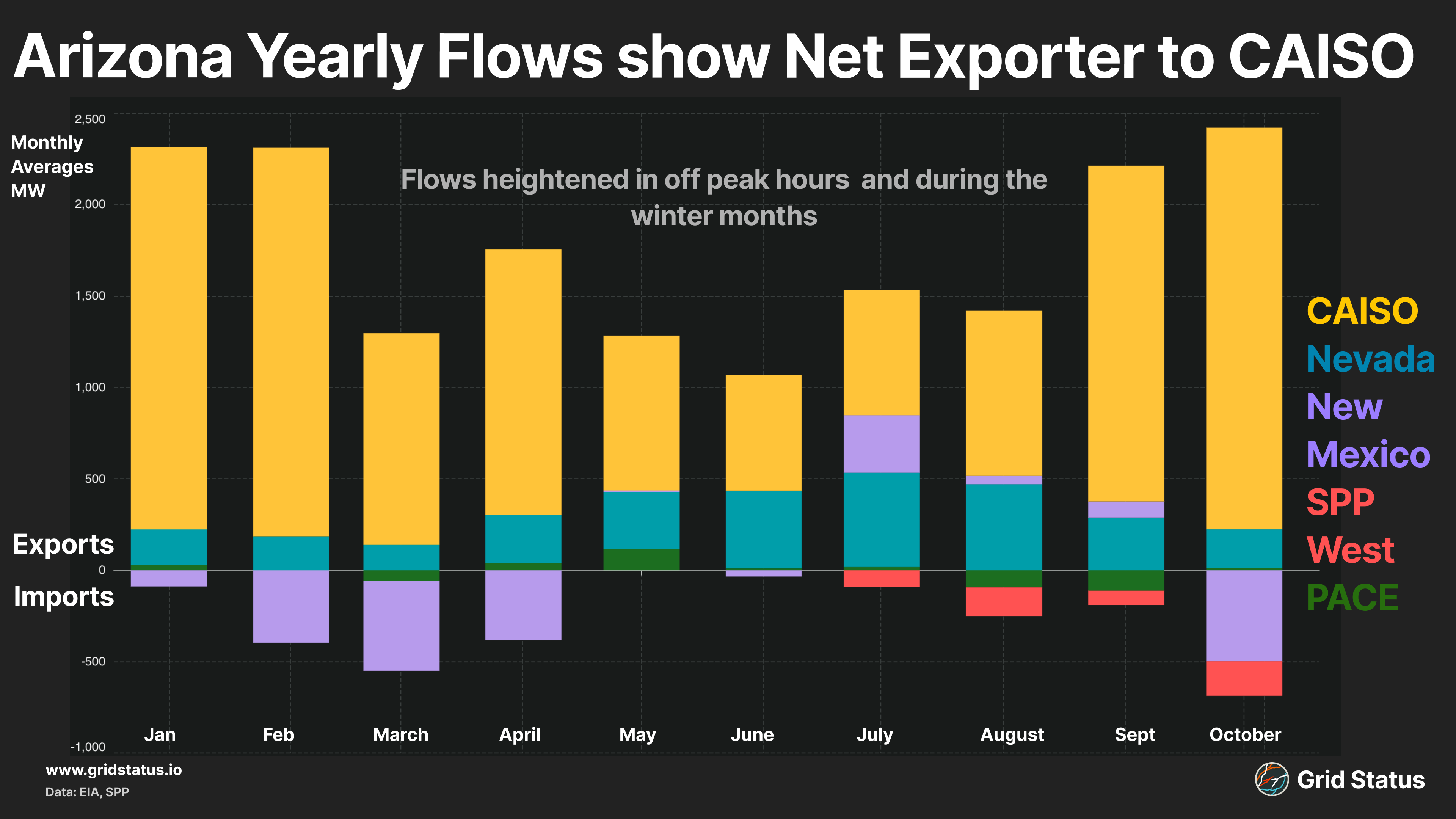
While it all nets out in the end, tracking where power comes from can be less clear-cut. If we aggregate around Arizona, we can see that it’s a net exporter to CAISO and Nevada (which, as we saw earlier, also exports to California). Depending on the season, New Mexico can help AZ out or require supporting flows if the wind is dead. SPP West even exported in small amounts to AZ as heat rose in the desert.
SPP West: Breaking boundaries and crossing lines
The newest addition and player in the Western Interconnection is SPP West (SWPW). SPP crossing the HVDC tie line brought SPP market processes into the frontier. Big changes don’t always go smoothly, and that has been evident in SWPW Hub’s price curve- anything but smooth. SPP West admitted that it was short on resource adequacy this summer from additional forced outages, but for the days after an initial outage, the impacts should be reflected in high Day Ahead pricing, so why are SPP West real-time prices so volatile? Signs may point to market design.
At the joint market seams meeting with representatives from CAISO and SPP on September 16th, Carman Ruder, a spokesperson for SPP, stated that SPP’s first line of defense is scarcity pricing. Per Attachment AE of the SPP Tariff, a Scarcity Price is defined as:
The Locational Marginal Price and Market Clearing Price levels determined through the use of Demand Curves when there is insufficient Energy or Operating Reserve available to meet the requirements.
For the SPP market, these requirements are calculated separately for the East and West BAs. Under regular tight conditions in the West, scarcity pricing has likely played a role. Across the month of August, we can see how frequently SWPW Hub spiked. The chart below shows the difference in prices compared to the prior interval. Price spikes happened frequently across all hours.
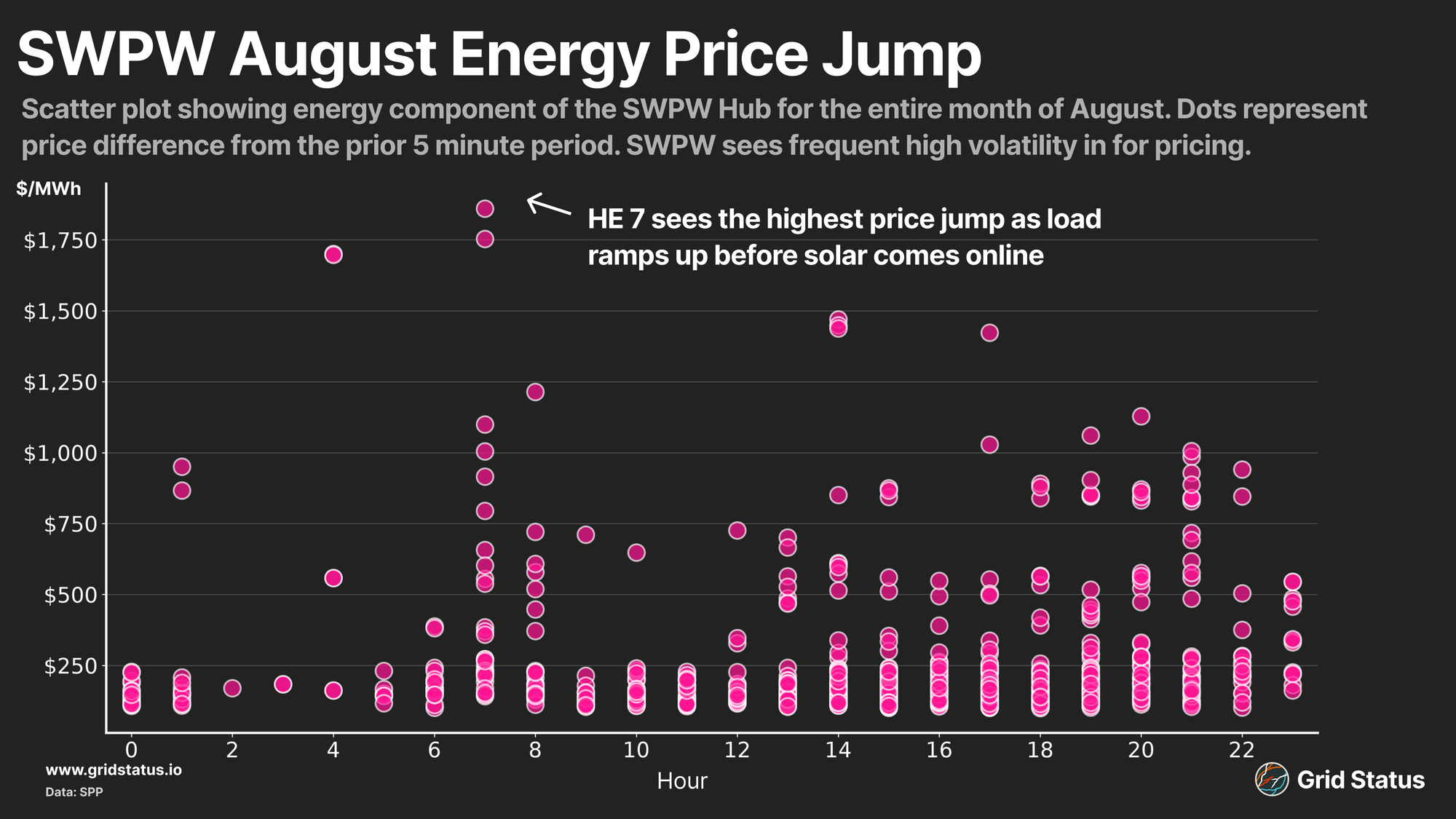
After these energy price spikes occur, the next step in the SPP process is to reduce pro-rata self-scheduled uncommitted export interchange bids. This means SPP's response is to then drop exports to other regions that were self-scheduled (and likely less important). The next step is to reduce pro-rata high-priority export interchange.
Forward information could substantially improve these situations, hopefully mitigating this price volatility. If Western Area Power Administration Lower Colorado (WALC) knew it would be short on resources 6 hours prior, then the wider system could plan ahead and not see such stark real-time price spikes.
Additionally, transparent market mechanisms have demonstrated SPP West’s sensitivity with respect to interchange with surrounding BAs. None of its neighbors are in an RTO, and currently only PACE is in a Day Ahead market, increasing the complexity of interaction between these grids. The extent to which SPP West operates under SPP's market rules despite SPP East being far less reliant on imports is something to watch in the market going forward. Additionally, the larger size of SPP East provides a cushion of stability, but does not translate the same for a smaller footprint.
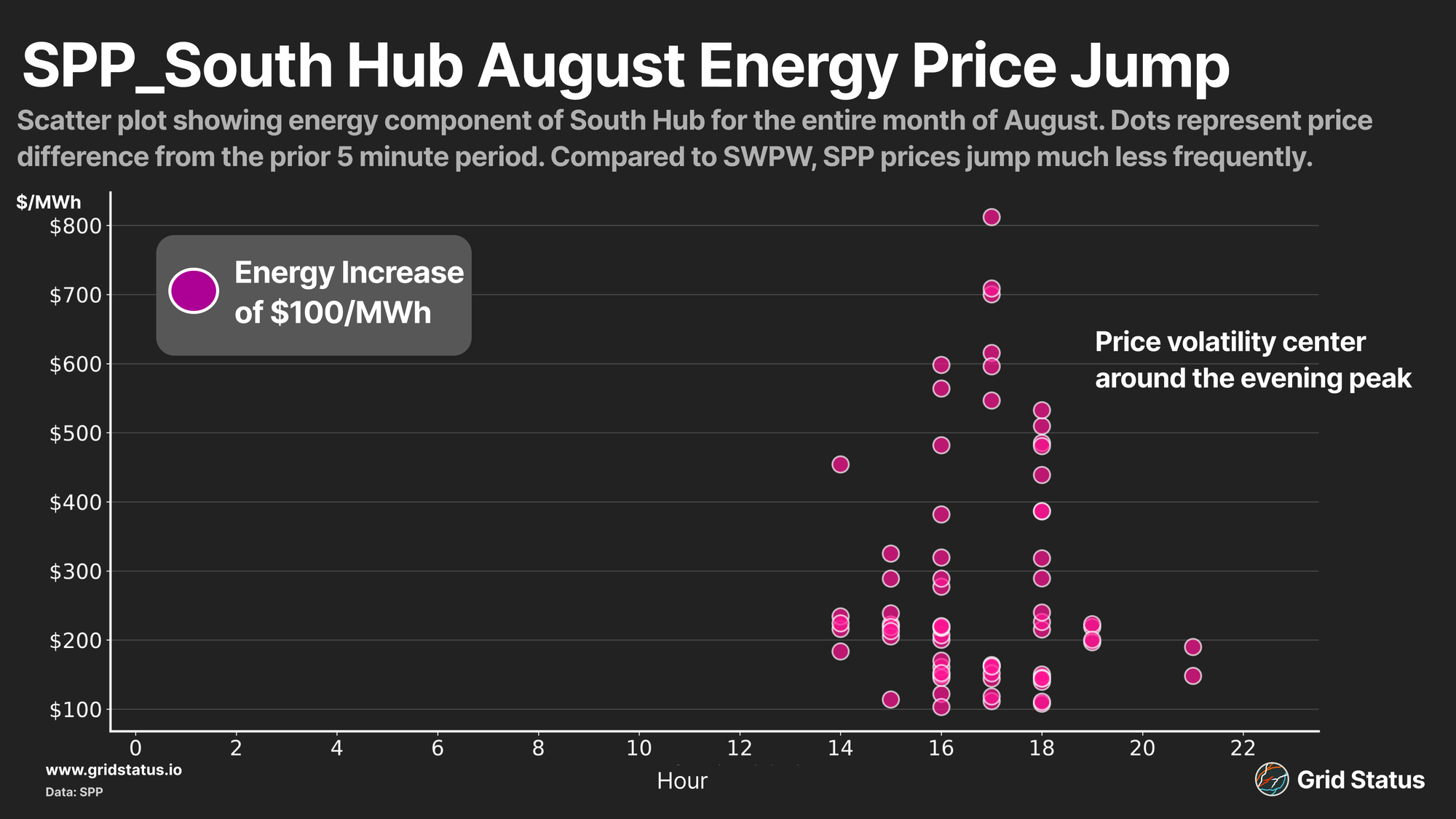
While SPP's market design has worked for the East, as these price jumps are most frequent during the evening load peak, with the expansion into the West and tighter conditions this summer, there will be design questions moving forward. Flows between the two SPP BAs are limited to the HVDC tie lines, which have been frequently in maintenance and are waiting for strong price signals to show up. It seems price volatility in the West is here to stay.
Forming Ties that Bind: EDAM
CAISO’s presence in the region has recently expanded with the new Extended Day Ahead market on May 1st. As of October 1st, EDAM now includes three balancing authorities: Portland General Electric (PGE), PACW, and PACE.
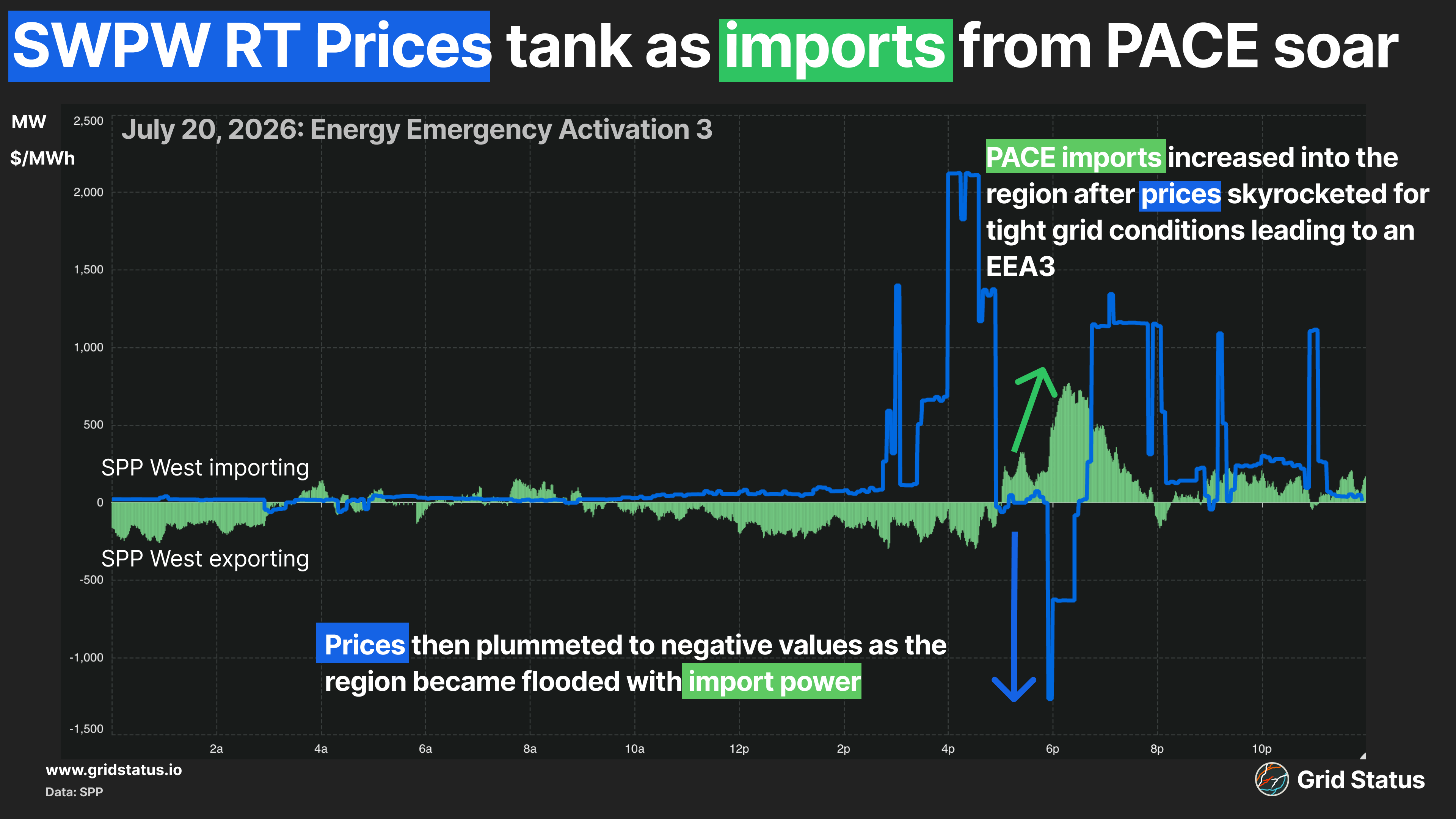
PACE interacts significantly with its neighbor to the East, SPP West. Post-SPP expansion, we have flow data in real-time. Flows from PACE were responsive to SWPW’s need for generation on July 20, 2026, when the region entered an Emergency Energy Activation 3 (EEA3). Prices at the SWPW_Hub reached the $2000/MWh bid cap, indicating a need for generation reaching the most expensive possibilities. PACE began exporting into SPP West, as did others, and the region was flooded with so much power that prices actually swung negative during the EEA. Since SPP uses price as an indication for scarcity, consistent exports from SPP switched exports to imports. The relationship of SWPW price and flows remains strongly correlated due to market tendencies. The reverse for PACE isn’t necessarily true, as CAISO begins to allocate flows as early as 7 days out in order for operators to start preparing.
The most common limit that the PacifiCorp transmission system runs into is thermal limits. Meaning the temperature of the lines runs into their design’s maximum allowable temperature. PacifiCorp has one of the most complex seams in the west. The transmission system in the BA was designed around concerns of too much flow moving out of the region and causing issues with reliability. Recently, however, there has been a paradigm shift, and now problems can arise with too high levels of incoming flows.
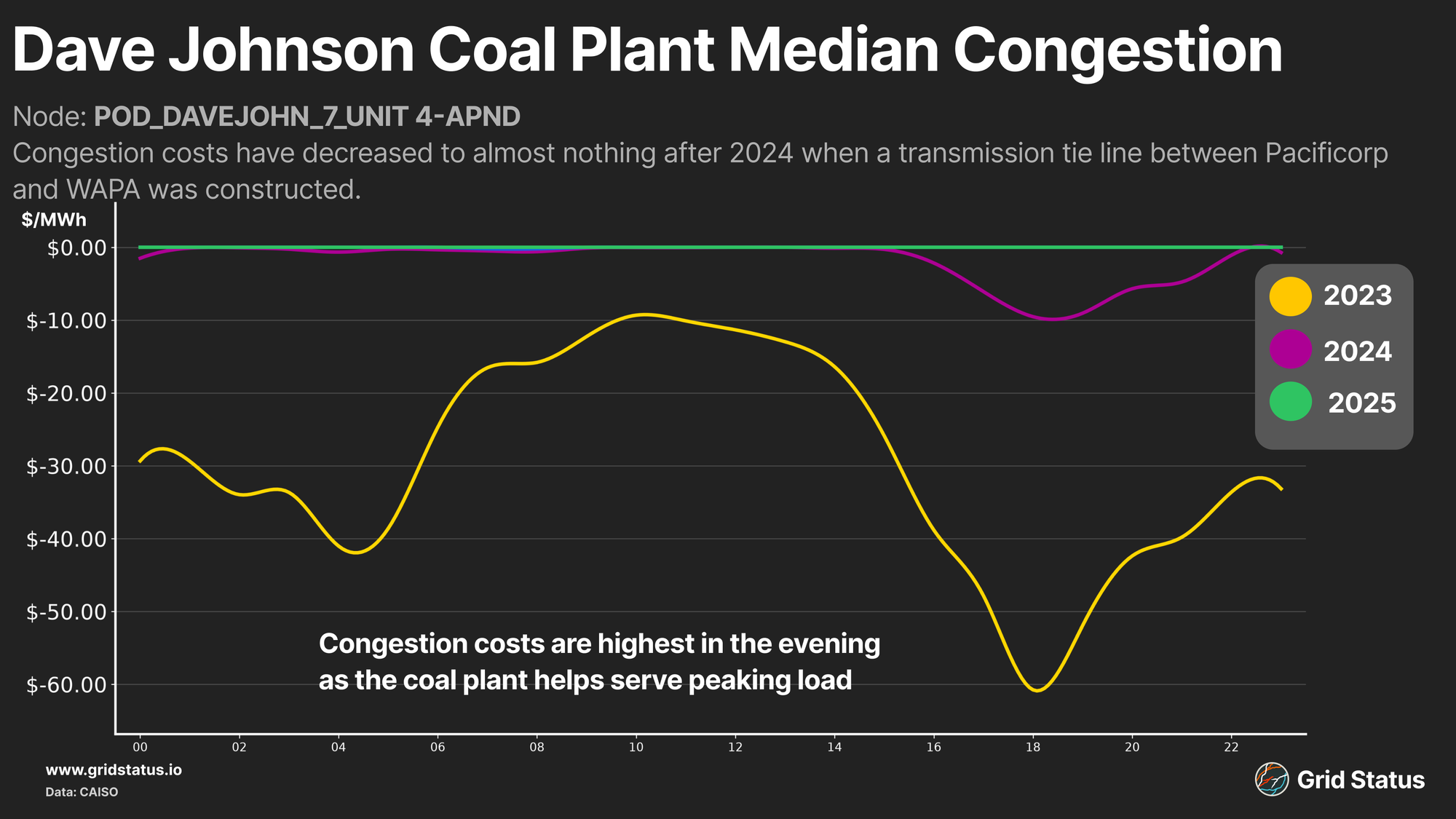
One example is Wyoming, where PacifiCorp built out generation beyond the ability of its transmission in the area to handle. The Amasa 230 kV line from Dave Johnson Coal plant connects eastern generation to the first 500kV substation. This problem was identified early on, and PacifiCorp ended up having to curtail generation in order to avoid issues. In 2023, issues along this line increased. Curtailment of generation at Dave Johnson has been correlated with an increase in generation in the Western Area Power Administration (WAPA) as the region still required capacity to serve load. Eventually, transmission reconfiguration was able to improve these problems and created a tie line between PacifiCorp and WAPA. Following this transmission upgrade, congestion significantly decreased, and generation from Dave Johnson was able to increase in 2024.
EDAM will continue to see friction in the seams as new balancing authorities get added. Next up is Nevada Power Company, centrally located and well connected, just east of CAISO, northwest of AZ, and south of the PACW and PGE. This addition will start to shift flows given its central location and just how much power is wheeled into CAISO through NEVP from all of the surrounding BAs.
Hydropower on the Monopoly Board: PNW
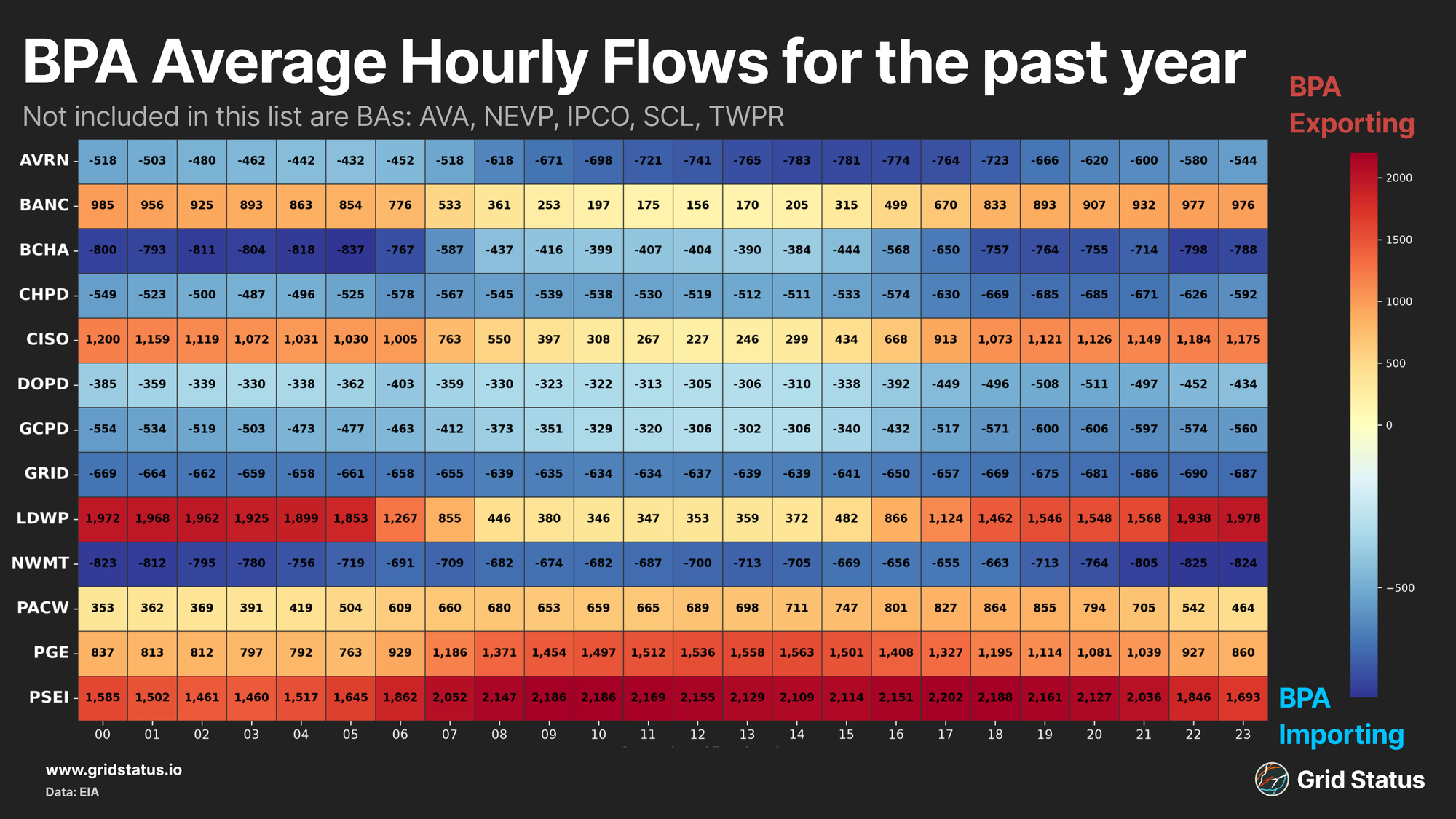
Pacific Northwest flows are largely ruled by Bonneville Power Authority, which owns and controls the majority of regional transmission. This provides the balancing authority with an unusual monopoly in the area. The data shows BPA as a net exporter with nearly every balancing authority across the region.
We can see the main Balancing Authorities' average flows from the past year from Bonneville Power. Puget Sound Energy sees the highest total flows, particularly in the on-peak period. LA Water and Power receives the greatest flows in the off-peak period. Regions that show BPA as a net importer are local Pacific Northwest regions that mostly have hydro power as their primary resource and are transmitting said power over BPA’s high-voltage system.
The near-monopoly on high-voltage transmission lines in the PNW leaves the region a bit more opaque than others in the West, but that doesn’t mean BPA is able to avoid the complexity that comes with the interwoven nature of seams.
The Logistics of Seams
After taking a look at how physical flows move around the Western Interconnect, let’s examine how flows move behind the scenes and between the seams. Balancing Authorities are not islands in the West, so seams are a necessary byproduct of the facilitation of transactions between entities. These transactions can be to support a system under stress or uncertainty, or be financial in nature, paying for use of transmission capacity in pursuit of a greater profit. Seams may have a negative connotation, but in a fractured environment they also represent points of interconnection. Originators, marketers, and load serving entities all trade across seams. Seams exist along different boundaries, including: BAA metered systems, TSP-owned systems, transmission service rights, market borders, and Resource Adequacy Program borders.
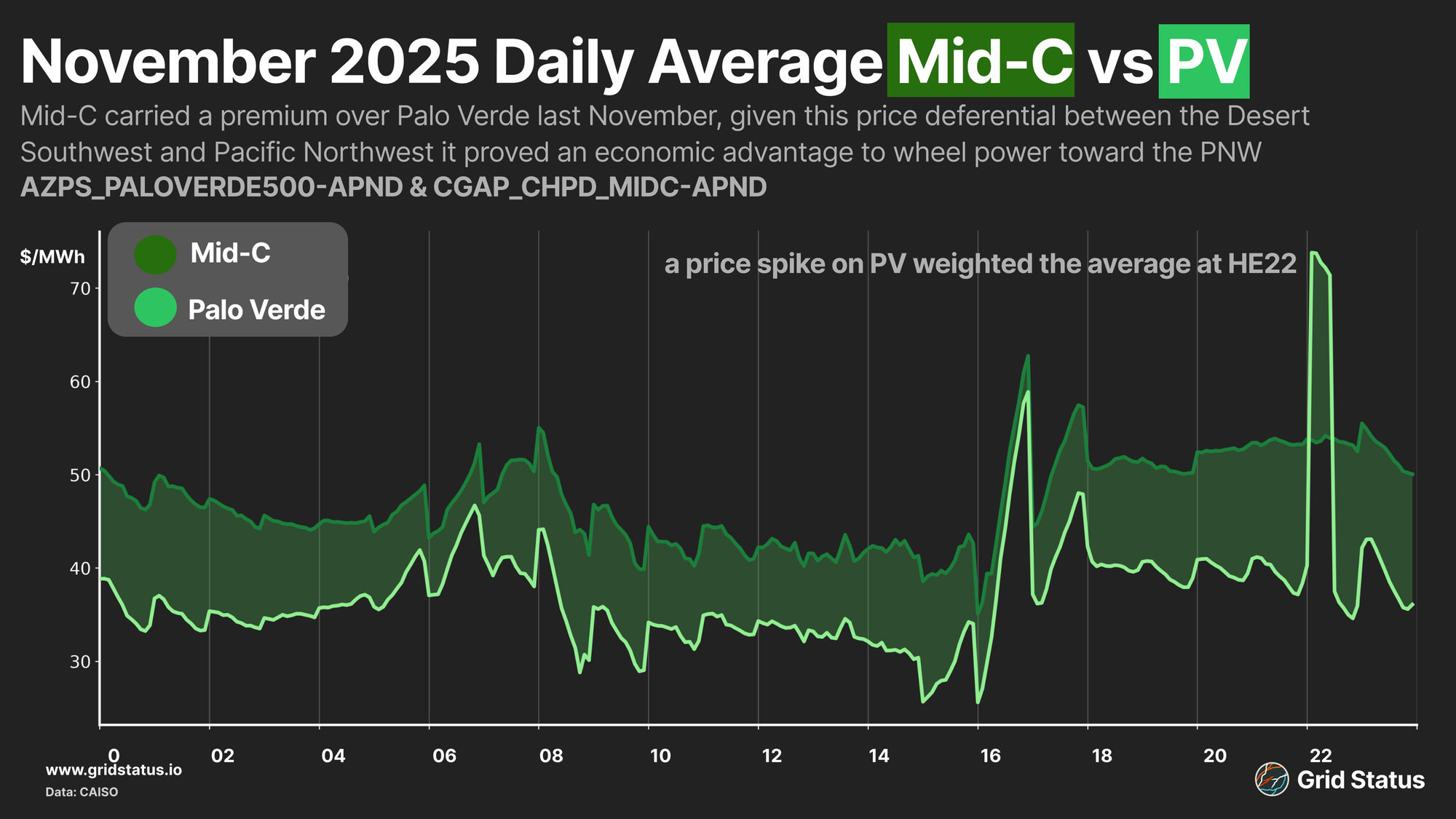
Trading is typically based on fundamentals; price can be a leading factor in the trade of power. Examining the price at Palo Verde vs. the price at Mid-C, the spread is what it would take to trade power between these corners of the West. In order to do so, you need to be aware of and potentially manage transmission rights, firm energy rights, virtual positions, and congestion rights. Overall, there is strong trading liquidity in the West, which often creates the appearance of free-flowing transactions.
Seams come with many different challenges. In SPP, the source and sink have to be lined up in advance to enter the day-ahead market, limiting economic activity in the day-ahead. On the other hand, CAISO has a portal for tagging interties AFTER the market clears. These differences between markets beget their own benefits and inefficiencies.
Additionally, the CAISO export market is limited by penalties if the organization is not part of EIM. An agreement was made between participants allowing use each other's transmission, so if organizations participate in EIM, they have a more open transmission system. However, this creates a seam between EIM and non-EIM entities since there is a transmission rights fee for those not participating in the program.
Other economic considerations are at play. CAISO has real-time self-schedules in order to move energy into the RTO, preventing active economic bidding action in those cases. Self-scheduling, however, comes with risk due to the volatility of the market. Together, this can reduce the appetite for inflows of surplus power in light of potential exposure risk.
With the elimination of the Western Energy Coordinating Council (WECC) soft price cap earlier this year, FERC removed a divergence between CAISO’s internal rules and the rest of WECC, creating market inconsistencies. Now, the markets have more consistency, aligning top price signals to attract extra supply.
Scheduling priorities can also create inefficiencies across seams. These particularly show up through resource adequacy (RA) requirements such that BAs will keep forward capacity rights, especially energy, within their home balancing authority. In recent years, CAISO has needed less external flows due to better internal resource availability during periods when the market was previously tight. This has reduced pressure that CAISO has put on surrounding BAs in the West to send power. As resource adequacy has freed up in some adjacent areas, this provided room for substantial data center and large load additions in neighbors such as Arizona.
Drawing New Lines
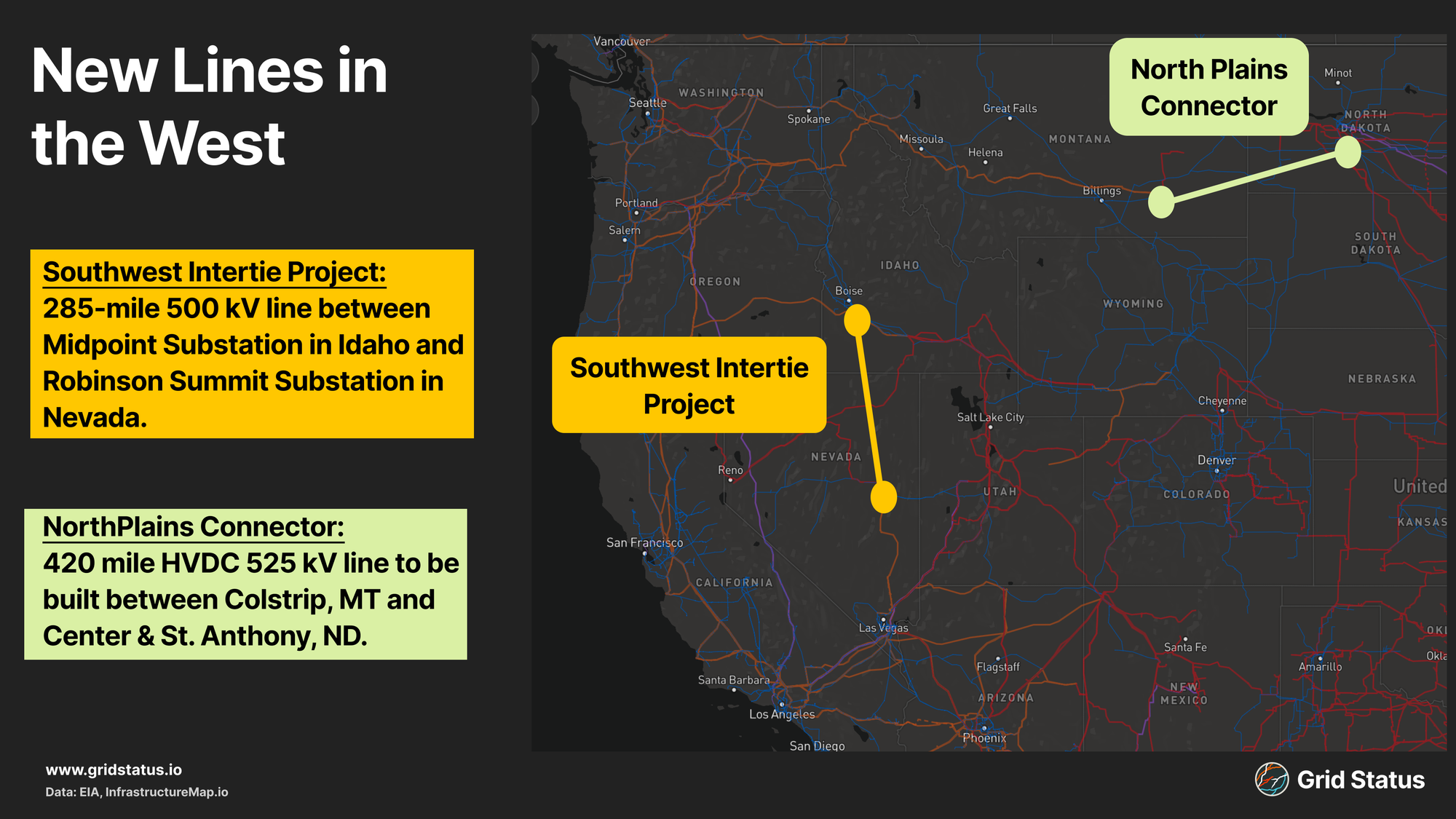
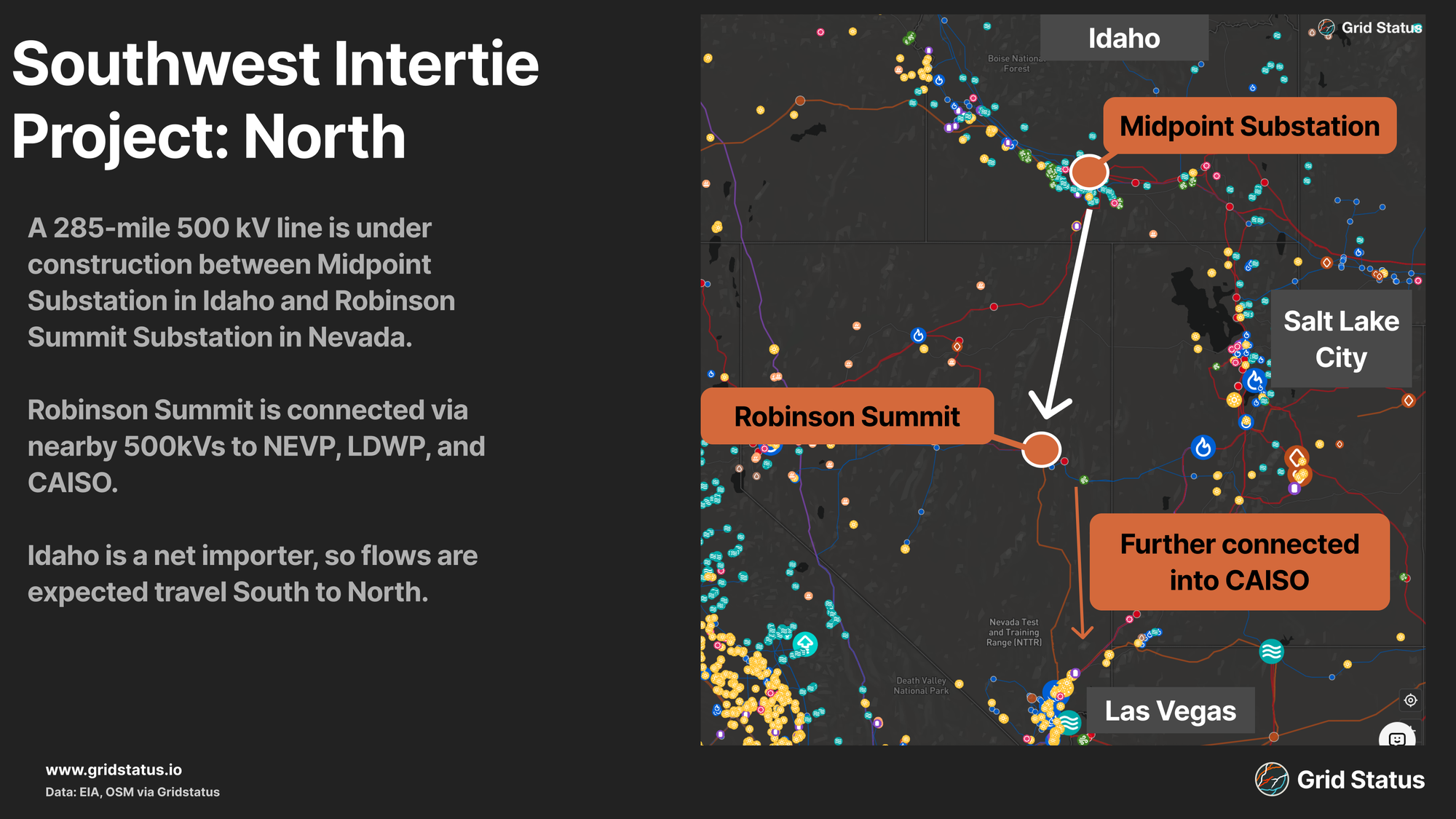
Construction has begun on a new transmission line between Idaho and Nevada, the Southwest Intertie Project-North. The SWIP-North is a 285-mile 500 kV line that will connect Midpoint, Idaho to Robinson Summit, Nevada. This line will then carry on to connect to the Harry Allen Substation and can further move power into the Las Vegas region via the extant 600-mile line.
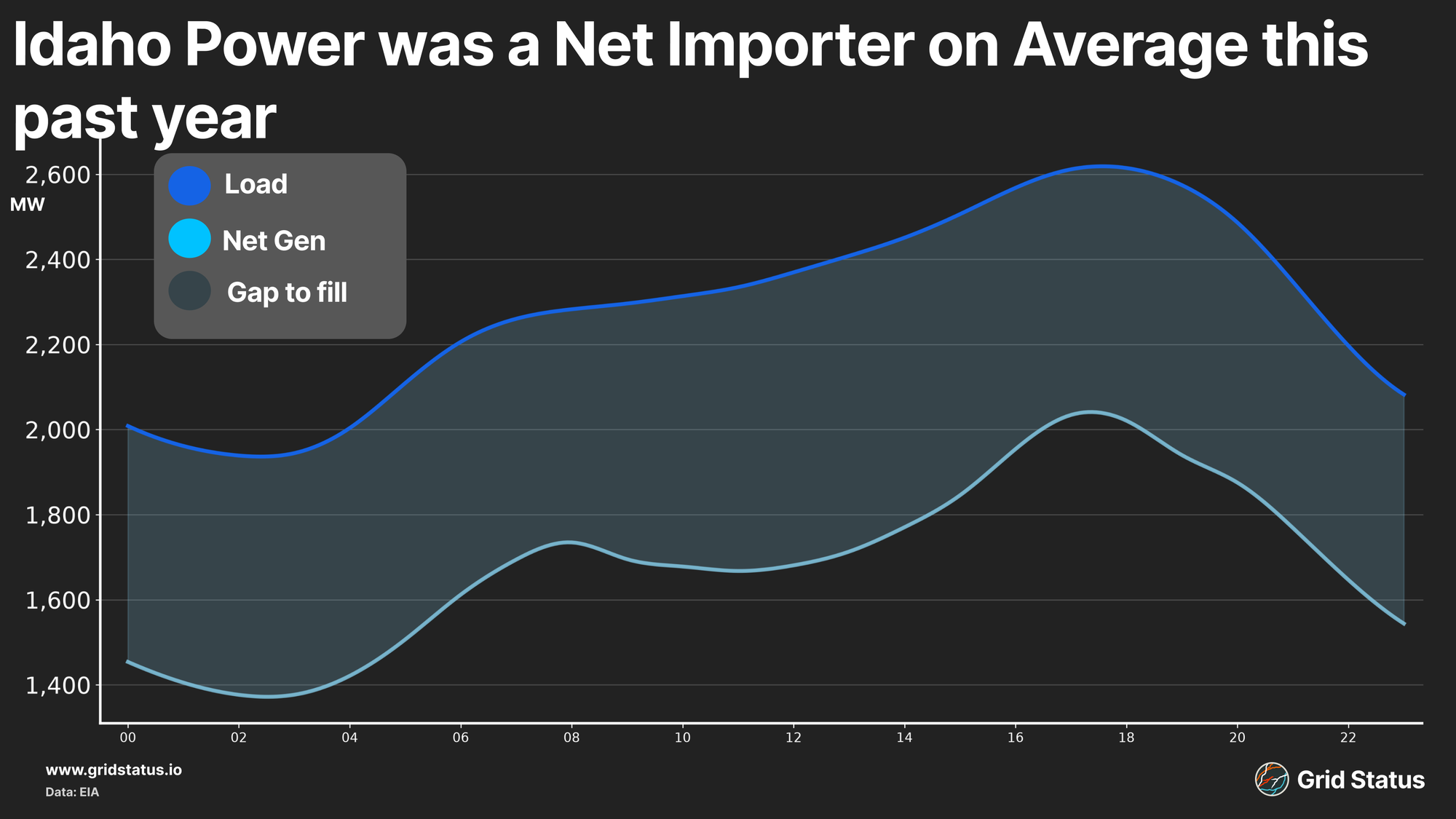
While CAISO has been heavily involved in the line since its inclusion in the ISO’s 2022-2023 Transmission Plan, it will also help service imports into Idaho Power, a BA in need of dispatchable generation. On average, net generation is well below load in Idaho. This occurs at all hours of the day and the main imports comes from PacifiCorp East, a founding participant in the EDAM market.
Meanwhile, the North Plains Connector seeks to better bridge the Eastern and Western Interconnections. Currently in the final rounds of approvals, this HVDC tie line will further connect Montana with North Dakota, increasing flows and interconnectivity with the eastern side of the country.
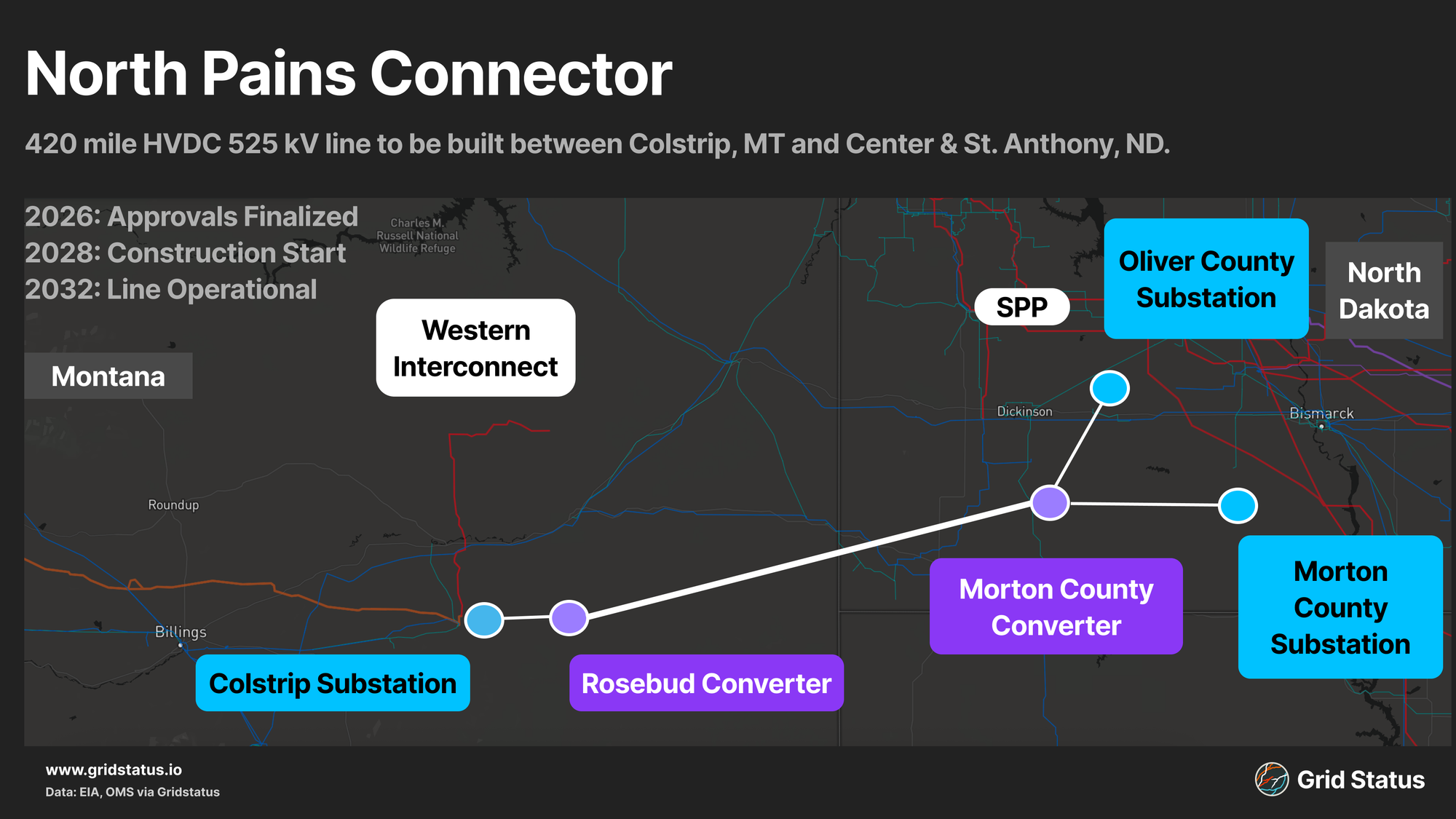
The Montana connection point is at the Colstrip substation, close to Miles City, which is a 200 MW HVDC tie connector for SPP and SPP West. Flows are relatively limited between these two portions of the RTO, making them feel distant. Adding an additional HVDC tie line will further help connect flows between the continental grids, allowing more efficient utilization of generating resources.
Dawn of the Future
We’ve only scratched the surface of what occurs behind the seams. Things are shifting in the West. With an expansion of an RTO, introduction of a Day Ahead market, and another DA market on the way, these seams will continue to change.
Some desirable outcomes from seams include simplicity at the intertie (less volatility, less risk, more reliability), avoiding risks in deliverability of key contractual obligations to load serving entities, full market functionality both self-schedule and economic bid, and transparency that input and output are clear to all entities
Should flows diverge from historical trends in a meaningful way on the back of policy changes, short-term pricing could change in certain markets, and long-term infrastructure might need to get build out as well. Western Market Interchange might not feel as exciting as the gold rush, but understanding this niche area of power markets might be more profitable in the long run. With the AI boom on the rise, energy is good as gold, and getting it to where it needs to go requires coordination across state, BA, and electrical lines. Getting seams right won’t be easy, but the benefits will accrue for longer than even any stakeholder call can feel.